Used Car Inspection Checklist for League City, TX
A Gulf Coast-specific checklist for inspecting a used car in League City, TX — flood damage, salt-air corrosion, and the exact items to verify before buying.
Before you buy a used car in League City, inspect these categories in order: flood and water-intrusion evidence, underbody and frame corrosion from Gulf Coast salt air, engine and drivetrain condition via an OBD-II scan and lift check, electrical and HVAC function, and a verified title and vehicle history report. A professional pre-purchase inspection (PPI) — separate from Texas's mandatory DPS safety and emissions test — is the fastest way to catch problems a test drive won't reveal.
The Gulf Coast used-car market is unlike almost any other in the country. Humidity, salt air off Galveston Bay, and the annual Atlantic hurricane season (June 1 through November 30) put stress on vehicles that inland buyers never think about. This checklist is built for that reality.
What flood-damage signs should you check first in a League City used car?
Start with flood evidence because it is the single most common hidden defect in the Southeast Houston used-car supply after major storms. Look for waterlines in the trunk spare-tire well, silt or rust under carpets and seat rails, corroded seatbelt retractors when pulled fully out, fogged headlights, and a musty odor beneath fresh air freshener. Any one of these warrants walking away or demanding a lift inspection.
Flood-branded titles surge along the I-45 corridor after hurricanes, and vehicles are often quietly moved between Harris, Galveston, Brazoria, and Fort Bend counties to obscure their history. Pull a title check and a vehicle history report on every candidate — and remember that not every flooded car ever gets a branded title. Physical inspection is the backstop.
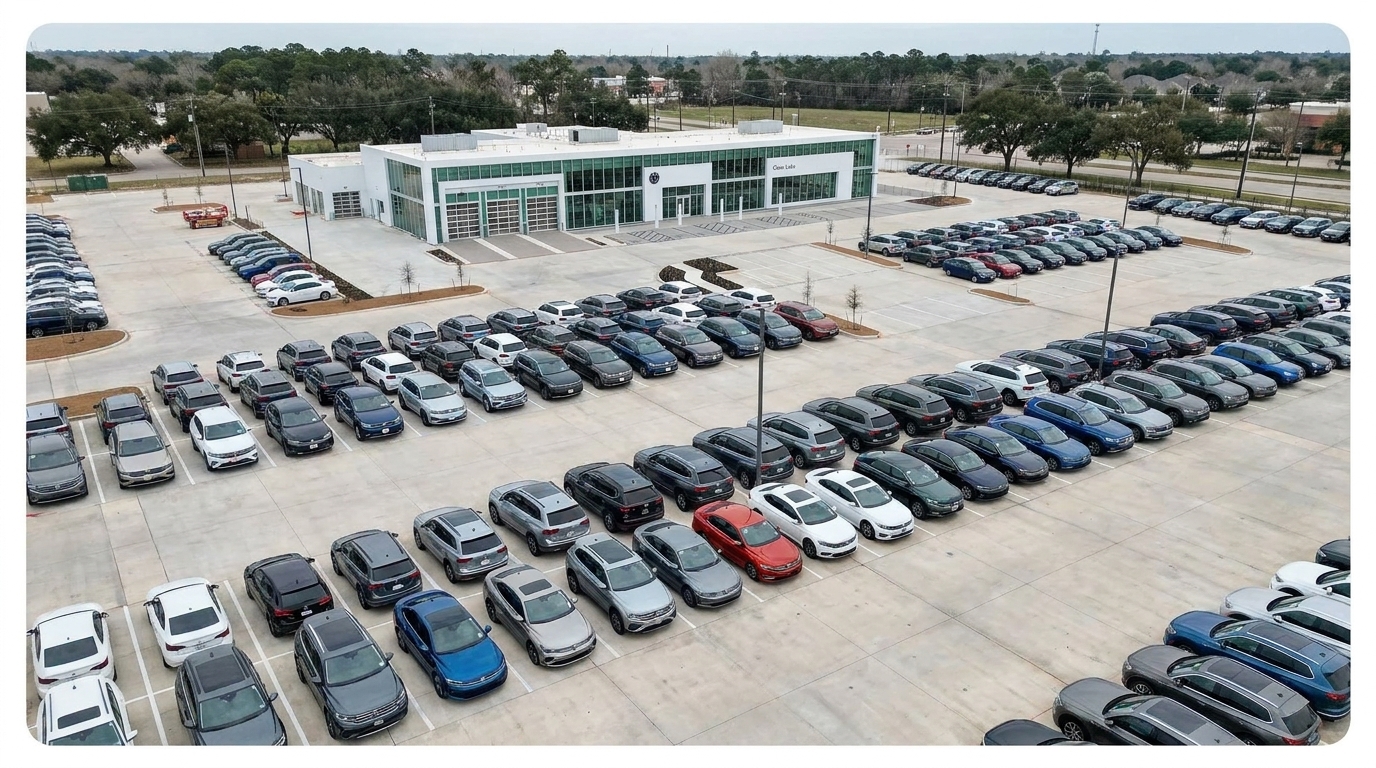
Volkswagen of Clear Lake, located at 3310 Gulf Freeway in League City, sees post-storm inspection demand spike every fall, and the pattern is consistent: buyers who skip the water-intrusion check are the ones who discover the problem months later when electronics start failing.
How do you inspect for salt-air corrosion on the underbody?
Get the vehicle on a lift and examine the frame rails, subframe mounts, brake lines, fuel lines, exhaust hangers, and suspension components for flaking rust, pitting, or scale. Surface rust is normal on any Gulf Coast vehicle; structural corrosion — where a screwdriver can flake material away — is a rejection signal. Pay special attention to electrical connectors and ground straps, which corrode invisibly in this climate.
Bay Area proximity accelerates this damage. Vehicles that spent time in Kemah, Seabrook, or the marinas along Clear Lake often show worse underbody condition than their odometer suggests. A car with 60,000 miles that lived near saltwater can have the underbody of a 120,000-mile inland car.
Brake components deserve their own check. Calipers seize, rotors pit, and parking-brake cables corrode faster here than manufacturers plan for. Ask the inspector to measure pad thickness and note any uneven wear.
What mechanical and electrical items belong on the checklist?
Cover these systems in every inspection: OBD-II scan for stored and pending codes, cold-start behavior, fluid condition and levels (oil, coolant, transmission, brake, power steering), belt and hose condition, battery load test, alternator output, all HVAC modes with a focus on A/C performance, every power accessory, and a road test that includes highway speeds and full braking. Skipping any one of these is where deals go bad.
A few Gulf Coast-specific notes. A/C is not optional equipment in this market — a weak system that "just needs a recharge" often means a leaking condenser or evaporator, which is a four-figure repair. Test the A/C at idle and at highway speed, in both recirculate and fresh-air modes. Check that the compressor cycles cleanly.
On the road test, take the car onto I-45 and hold highway speed for at least ten minutes. Transmission issues, wheel-bearing hum, and alignment pull only show up under sustained load.
How much does a pre-purchase inspection cost in the League City area?
Expect to pay $75 to $125 for a basic visual pre-purchase inspection, $100 to $250 for a standard comprehensive PPI with OBD scan, lift, and a written report on a mainstream sedan or SUV, and $200 to $400 or more for specialist inspections on luxury, performance, or European vehicles. Mobile inspections in the Houston metro typically start at $100 to $250 plus any travel fee for cross-county appointments.
Pricing varies by scope, not by ZIP code. A 200-point bumper-to-bumper inspection costs more than a 50-point visual because it takes longer and requires diagnostic equipment. For a vehicle you plan to keep five years, the higher tier pays for itself the first time it flags a serious issue.
| Inspection type | Typical price range | Best for |
|---|---|---|
| Basic visual PPI | $75 – $125 | Low-value vehicles, quick sanity check |
| Standard comprehensive PPI (mainstream sedan/SUV) | $100 – $250 | Most private-party and used-lot purchases |
| Specialist / luxury / European PPI | $200 – $400+ | German, performance, high-mileage luxury |
| Mobile PPI (base fee) | $100 – $250 | Private sellers, cross-county inspections |
What Texas paperwork and legal items do you verify before buying?
Confirm four documents on every used-car purchase in Texas: a clean, unbranded title matching the seller's ID, a completed Application for Texas Title (Form 130-U), a current or recent Texas vehicle inspection record if the vehicle is subject to it, and an odometer disclosure for vehicles under ten model years old. A pre-purchase inspection is voluntary and does not replace any of these.
Texas requires gasoline vehicles aged 2 to 24 years in the Houston region — Harris County and surrounding counties — to pass an annual DPS safety and emissions inspection. New vehicles under two model years old, vehicles over 24 years old, diesels, and EVs are exempt from that mandatory inspection but still benefit from a private PPI. Note that PPI providers themselves are not licensed by any specific Texas statute; they operate under general business rules and consumer-protection law.
Should you use a mobile inspector or a shop-based inspection in this market?
Use a mobile inspector when the vehicle is at a private seller's home, at an out-of-county dealer, or anywhere transporting it is impractical — common in the Harris/Galveston/Brazoria/Fort Bend used-car ecosystem. Use a shop-based inspection when the seller will release the car for a few hours and you want lift access, a full fluid analysis, and diagnostic tools that don't travel well. Both formats are legitimate; the vehicle's location usually decides.
For franchise-brand used cars, a manufacturer-trained service department carries a real advantage — they know the model's known failure points, recall history, and software update status in a way a generalist inspector may not. Volkswagen of Clear Lake, for example, sees VW-specific issues on the same platforms every week and knows exactly where to look.
When during the year is inspection demand highest in League City?
Two predictable spikes and one unpredictable one. Tax refund season in early spring drives the first surge as buyers put returns toward down payments. Late summer brings a back-to-school spike as families upgrade before the school year. The unpredictable spike is post-hurricane — after any named storm that produces flooding, PPI demand jumps for weeks as flood-damaged inventory quietly enters the market.
Book earlier during these windows. Same-week appointments get harder to find, and rushing a PPI defeats its purpose.
Frequently asked questions
Is a Texas state inspection the same as a pre-purchase inspection?
No. The Texas state inspection is a mandatory annual safety and emissions test administered by DPS-certified stations for gasoline vehicles aged 2 to 24 years in the Houston region. A pre-purchase inspection is a voluntary private service that evaluates the vehicle's overall condition — mechanical, structural, electrical, and cosmetic — for a specific buyer before purchase. They serve different purposes and one does not replace the other.
Can a pre-purchase inspection detect all flood damage?
A thorough PPI catches most flood damage, but not all. Skilled sellers clean cars aggressively, and electronic damage from saltwater intrusion can take months to manifest. Combine a physical inspection with a vehicle history report, a title check for flood or salvage brands, and a careful look at trunk wells, seatbelt retractors, and under-carpet areas. If any two indicators line up, walk away regardless of what the paperwork says.
Do I need a PPI if I'm buying from a franchise dealership?
An independent PPI is still worthwhile, especially on non-certified used vehicles. Certified pre-owned programs include manufacturer-backed inspections and warranties, which reduce risk substantially. On a standard used vehicle from any dealer, an independent inspection gives you leverage in negotiation and confirms nothing was missed. The cost is small relative to the purchase price.
How long does a comprehensive pre-purchase inspection take?
A standard comprehensive PPI typically takes 60 to 120 minutes, including the OBD-II scan, lift inspection, fluid checks, road test, and written report. Specialist inspections on European or performance vehicles can run longer. Plan for at least half a day between dropping the vehicle off and receiving the finished report, and longer if the shop is working through a seasonal backlog.
Are diesel trucks and EVs exempt from Texas inspection requirements?
Diesel vehicles and EVs are exempt from the mandatory Texas safety and emissions inspection program, as are new vehicles under two model years old and vehicles over 24 years old. Exemption from state inspection does not mean these vehicles don't benefit from a private pre-purchase inspection — EV battery health checks and diesel emissions system inspections are especially important on used units.
What's the biggest inspection mistake buyers make on the Gulf Coast?
Skipping the underbody lift check. Buyers focus on paint, interior, and the test drive, then discover after purchase that frame rust, corroded brake lines, or a seized suspension component will cost thousands to address. Salt air, humidity, and occasional flood exposure make the underbody the single most important area to inspect on any used vehicle sold along the Southeast Houston coast — and it's the area a walk-around visual will never catch.
Getting a used-car inspection done right
The right pre-purchase inspection for a League City buyer is one that reflects the Gulf Coast environment: flood evidence, salt-air corrosion, A/C performance, and clean title paperwork, in addition to the standard mechanical and electrical checks. Skip any of those categories and you're buying blind in the market that arguably needs a thorough inspection more than any other in Texas.
Readers in League City who want a manufacturer-trained team to handle the inspection — or who are shopping a used Volkswagen and want it looked over by people who know the platform — can reach Volkswagen of Clear Lake at 3310 Gulf Freeway, League City, TX 77573, by phone at (832) 432-7969, or online at https://www.vwofclearlake.com/ to get started.